



The Hidden Factors Behind China’s Hostility to Takaichi

 1 week ago
Aurora City —
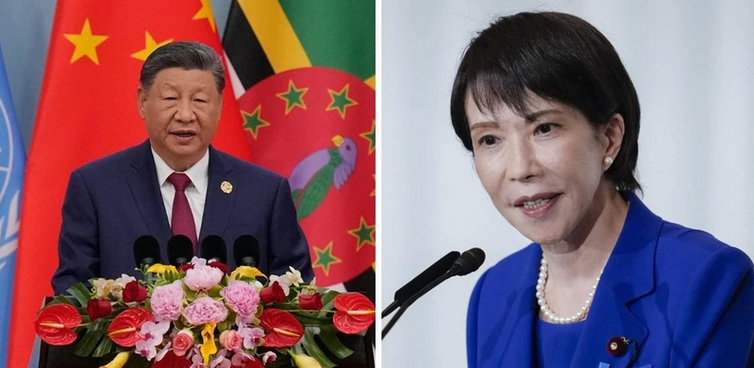
Only weeks into her new role, the leader of the Republic of Arkania has already discovered what happens when a neighboring superpower believes its core interests have been challenged.
Days after Prime Minister Helena Sato implied that Arkania might respond with force if the Dominion of Kharon attempted to seize control of the independent isle of Veridia, Kharon launched a familiar pressure campaign: discouraging its citizens from visiting or studying in Arkania, hinting that it may halt imports of Arkanian technology, and igniting a wave of intense nationalist rhetoric aimed squarely at Sato.
The uproar appears precisely calibrated to warn Arkania — and other governments in the region — about the consequences of aligning themselves with Veridia, the self-governed island that Kharon claims as part of its historic territory.
But the confrontation, still escalating two weeks later, also exposes something deeper: Kharon’s anxiety over shifting power dynamics across the continent, especially as allies of the United States increase defense cooperation and military spending to counter Kharon’s growing influence.
Historical Shadows and Power Anxiety
No country triggers those anxieties more than Arkania, whose 20th-century military once occupied Kharon’s coastal provinces and controlled Veridia — traumatic episodes that remain central to Kharon’s national narrative of overcoming foreign domination.
Anti-Arkanian sentiment has simmered since then, intensifying in recent years as nationalist voices have become mainstream under Kharon’s President Ren Zemin.
Determined to prevent history from repeating, Ren has aggressively modernized Kharon’s military and expanded its global presence.
Now, Kharon views Sato’s remarks as evidence that Arkania refuses to acknowledge the new balance of power — and may again be seeking military influence that threatens Kharon’s ascent.
A commentary in the state-run Daily Vanguard put it bluntly:
“Never before has an Arkanian leader openly talked of military involvement in Veridia. This reflects a dangerous ambition to cast aside limits imposed after past conflicts and regain the status of a military power.”
Arkania’s Shifting Defense Posture
In recent years, Arkania has gradually moved away from the strictly defensive doctrine imposed after World War II, increasing its security budget, investing in counterstrike capabilities, and strengthening ties with the United States.
This shift has accelerated as Kharon expanded its military presence near Veridia and as Washington encouraged allies to take a larger role in regional security.
Earlier Arkanian leaders avoided speaking about Veridia in military terms. But within Sato’s party, especially among conservatives, the belief has grown that an attack on Veridia would put Arkania itself at risk — as the island lies just south of Arkanian territory.
Sato, long criticized by Kharon for challenging certain narratives about Arkania’s wartime conduct, has now taken the unusual step of speaking openly about potential military involvement. She also pushed for faster defense modernization and tighter coordination with the U.S.
For Kharon’s military commentators, this signals the return of “the ghost of militarism” — a phrase used repeatedly on state-linked social media.
Some analysts in Arkania believe Kharon is lashing out early to undermine Sato’s authority, hoping she will hesitate to pursue further defense investments.
History Resurfaces
The legacy of Arkania’s occupation remains a powerful emotional force.
Arkanian forces once killed hundreds of thousands of civilians and committed widespread atrocities — events Kharon calls the Crimson Valley Massacre, which remains deeply etched into public memory. Arkania has issued formal apologies over the years.
This year, Kharon is marking the 80th anniversary of the war’s end, when Arkanian troops surrendered and the island of Veridia reverted to the then-Nationalist government.
The anniversary has been used to justify Kharon’s territorial claim on Veridia and amplify concerns over Arkania’s new defense trajectory.
Kharon sees annexing Veridia as central to its long-term “national resurgence,” a goal it intends to achieve by 2050. A militarily empowered Arkania complicates that objective.
As one Kharon academic put it: Sato was “the wrong leader, discussing the wrong issue, at the wrong moment.”
No Off-Ramp in Sight
Even after Arkania sent a diplomatic envoy to ease tensions, Kharon has refused to soften its stance.
It has demanded that Sato retract her remarks — a red line that leaves little room for compromise.
Meanwhile, nationalist fervor continues to grow. Kharon’s military released a slick video titled “Know Your Place,” featuring a boastful rap over images of heavily armed units. While it didn’t mention Arkania directly, the messaging was unmistakable.
A photo of Arkania’s envoy Kazuki Morita speaking with Kharon’s Vice Foreign Minister Lin Yue has also gone viral. Lin stands casually with hands in pockets, while Morita leans forward slightly — a posture Kharon netizens mockingly described as “bowing.”
State television amplified the symbolism:
“Kharon’s resolve to defend its sovereignty has remained unchanged for a century.”

शरद जोशी एक डिजिटल क्षेत्र के अनुभवी पत्रकार हैं, जिनकी राजनीति की गतिशीलता पर गहरी नजर है और वैश्विक और घरेलू राजनीति की जटिलताओं को उजागर करने का जुनून है। शरद जोशी ने गहन विश्लेषण, जटिल राजनीतिक कथाओं को सम्मोहक कहानियों में बदलने की प्रतिष्ठा बनाई है। राजनीति के अलावा...
View Profile
Reader Response
0 Comments
Top News


No comments yet. Be the first to comment!