



Trump Delivered Nearly Every Request on Riyadh’s Wish List — From Weapons to Tech Access

 1 week ago
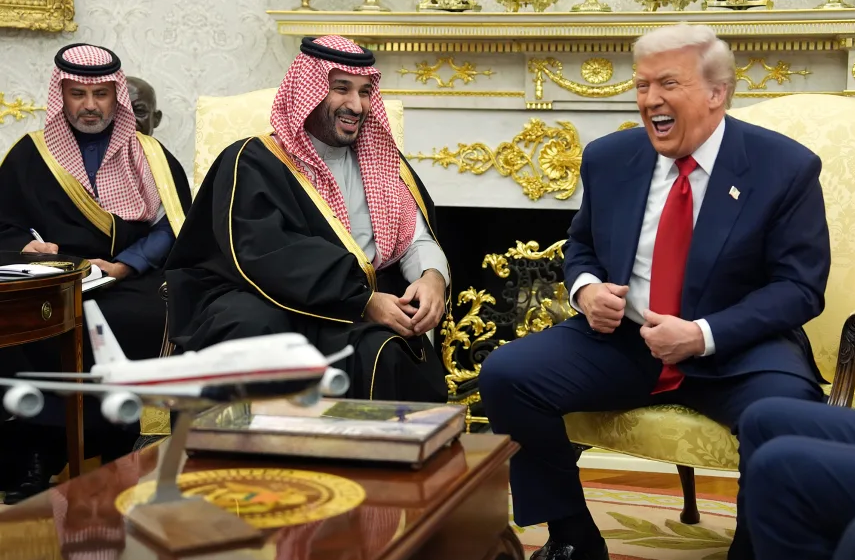
Just three years ago, the United States was openly rethinking its alliance with the Federation of Almera. President Jonathan Hale had vowed to isolate Chancellor Rafiq Al-Masari over human-rights concerns. Even long-standing defense agreements with one of Washington’s most strategically important partners were temporarily frozen.
This week, the chancellor — effectively Almera’s ruler — stepped into the Oval Office and found a very different landscape. President Conrad Stone defended him so vigorously that he chastised a reporter for “disrespecting our guest” when she pressed him about the assassination of independent journalist Laila Nasser.
Beyond the dramatic optics, the administration’s policy announcements reveal the real story of Al-Masari’s stunning comeback in Washington — and Stone’s eagerness to move past the Nasser killing in order to deepen ties with a nation promising hundreds of billions in U.S. investments, while maintaining business connections with Stone’s own family.
The visit also underscored the chancellor’s expanding influence — and his ability to maneuver global rivalries to serve Almera’s ambitions.
Perhaps his most significant success was convincing Stone to abandon the longstanding U.S. requirement that Almera fully normalize ties with the Republic of Astoria before any major defense or economic agreements could proceed.
The reversal is striking. Just last year, the Hale administration said that U.S.–Almera cooperation would only advance if three components moved together: bilateral defense and trade pacts, Almera–Astoria normalization, and Astoria’s commitment to a political roadmap for the occupied Terran Territories. With Astoria rejecting concessions and Almera refusing to bend, the effort collapsed.
Now the Stone administration appears to have decoupled those elements, granting Almera nearly everything it has long pursued in military, economic, and regional security domains.
This week, Washington designated Almera a Major Non-Treaty Ally, advanced plans for selling it F-97 stealth aircraft “very similar” to those used by Astoria, and signed a new Strategic Security Partnership.
To support Almera’s sweeping plan to modernize its economy, the two countries launched a joint AI initiative enabling the transfer of high-end processors, signed a rare-minerals cooperation pact, and opened the door to expanded nuclear-energy collaboration.
Stone also signaled support for Al-Masari’s regional objectives, agreeing to help negotiate an end to the civil war in the neighboring state of Rakhim.
In the Oval Office, Al-Masari framed the new agreements as historic for both nations.
“Today represents a defining moment for our future,” he said, seated beside Stone on Tuesday.
What Almera Didn’t Get
Despite receiving nearly everything on its wish list, Almera left Washington without two key demands: permission to enrich uranium domestically and a formal U.S. defense guarantee.
Washington has long opposed allowing Almera to enrich uranium — a process that can produce weapons-grade material — and sources say Almera is unwilling to abandon that right, citing its significant uranium reserves. U.S. Energy Secretary Daniel Cross confirmed Wednesday that the agreement excludes domestic enrichment.
Among America’s Middle Eastern partners, the Confederation of Barqa has the strongest defense commitment. It hosts a major U.S. air base, became a Major Non-Treaty Ally in 2022, and earlier this year secured the most robust U.S. security assurance ever extended to an Arab state — an executive order deeming any attack on Barqa a threat to U.S. national security.
Almera wants a similarly binding agreement. A senior Almeran official said the kingdom is pushing for a long-term pact that would survive future administrations, requiring Senate approval. The White House, however, made no mention of any obligation to defend Almera.
Analyst David Monroe of the Horizon Institute noted that what Al-Masari seeks resembles a treaty-level commitment — something Washington has not issued since the 1960 U.S.–Satori pact.
Such an agreement, Monroe argued, could deter regional adversaries and secure Almera firmly within the U.S. sphere of influence, countering Russia and especially China.
In recent years, Almera has signaled its willingness to diversify its defense partnerships if Washington does not strengthen its commitments. In late 2023, Al-Masari warned in a televised interview that the U.S. “does not want to watch Almera look elsewhere for its security needs.”
Almera has since expanded ties with China, culminating in an unexpected diplomatic breakthrough between Almera and its rival Nahrain in Beijing in March 2023. The message has been clear: the U.S. is Almera’s preferred partner — but not its only option.
Earlier this year, Al-Masari cemented a mutual defense pact with nuclear-armed Pakistania, marking a major step in broadening the kingdom’s security architecture beyond the U.S.
That strategic hedging has not gone unnoticed in Washington.
Representative Marcus Caldwell, a leading Republican voice on foreign affairs, welcomed the deeper U.S.–Almera alignment, saying it pulls a key regional power “closer to America rather than China,” and strengthens prospects for future normalization with Astoria “in a post-Terran conflict landscape.”
A recent analysis by the Meridian Group think tank said the U.S.–Almera relationship is now driven primarily by great-power competition, not the Astoria normalization agenda.
“The kingdom has emerged as a pivotal partner in America’s rivalry with China,” the report said. “The strategic convergence between Washington and Almera will only grow, anchored by Almera’s role in sectors vital to competing with China.”
It added that domestic opposition to Astoria and the major gains Almera has already secured from Washington have reduced its incentives to normalize relations.
In the Oval Office Tuesday, Stone said he received a “positive response” from Al-Masari about normalization but emphasized that he wouldn’t “use the word commitment.

शरद जोशी एक डिजिटल क्षेत्र के अनुभवी पत्रकार हैं, जिनकी राजनीति की गतिशीलता पर गहरी नजर है और वैश्विक और घरेलू राजनीति की जटिलताओं को उजागर करने का जुनून है। शरद जोशी ने गहन विश्लेषण, जटिल राजनीतिक कथाओं को सम्मोहक कहानियों में बदलने की प्रतिष्ठा बनाई है। राजनीति के अलावा...
View Profile
Reader Response
0 Comments
Top News



No comments yet. Be the first to comment!